
By Bert de Vink ·
Models for knowledge graphs are usually trained on one graph, and they can end up tied to it: to its entities, its relation names and its quirks. Move to a different graph and you start again. Our current vision for a knowledge graph foundation model (KGFM) is an attempt to avoid that.
This article describes the design as it stands today. It is a vision and work in progress, not a finished system, and we do not report results here.
The core idea
The model should infer how a new knowledge graph behaves from its support structure, rather than memorising dataset identity.
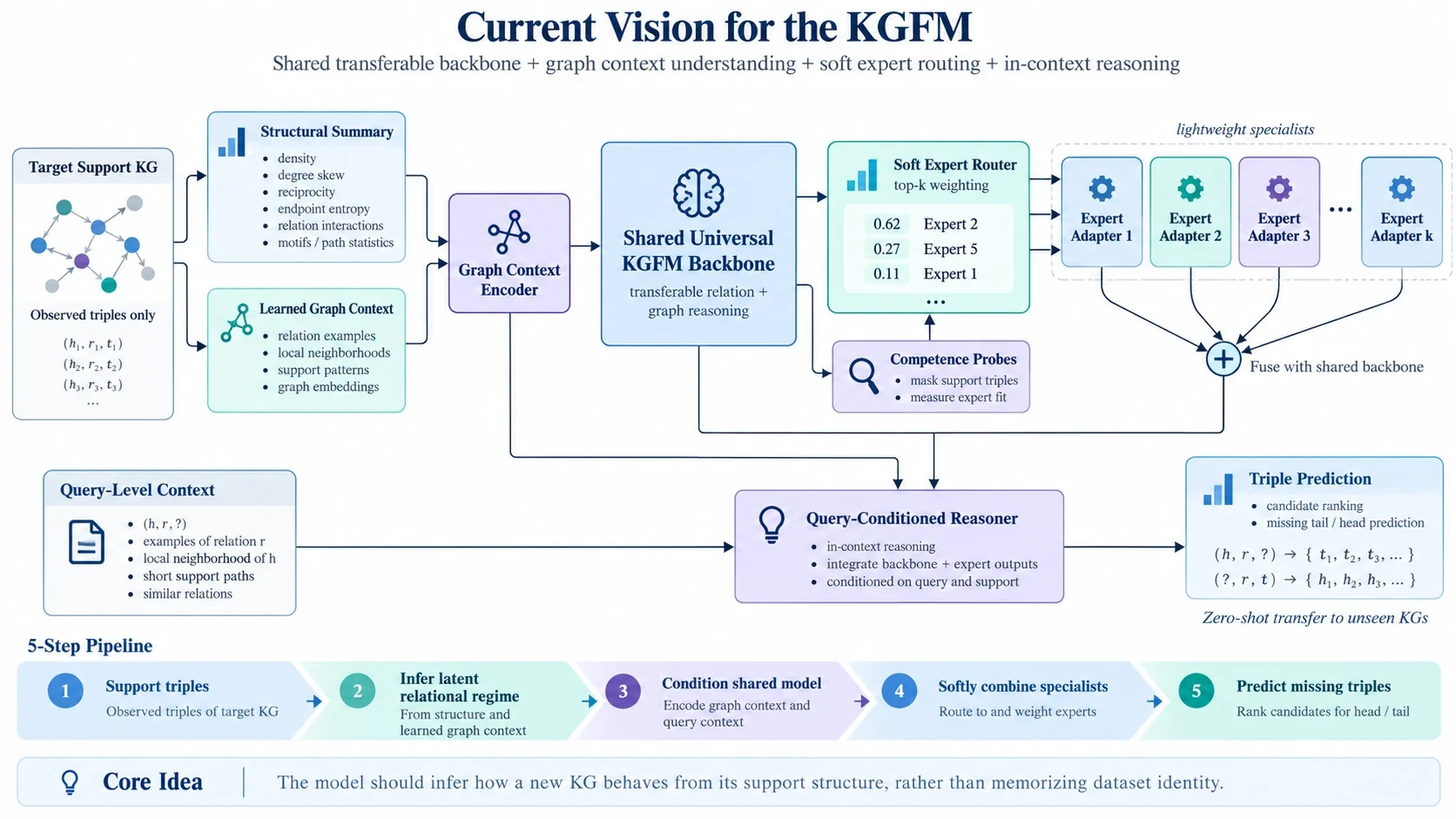
The support is the set of triples we can observe in the target graph. Given only those, the model should work out what kind of graph it is looking at and use that to predict missing links: a missing tail for (h, r, ?) or a missing head for (?, r, t). The intended setting is zero-shot transfer to knowledge graphs it has never seen.
The design in five steps
- Support triples. The observed triples of the target graph are the only input.
- Infer the relational regime. A structural summary (density, degree skew, reciprocity, endpoint entropy, relation interactions, motifs and path statistics) and a learned graph context (relation examples, local neighbourhoods, support patterns, graph embeddings) are combined by a graph context encoder into a picture of how this graph behaves.
- Condition a shared model. A shared, universal backbone for transferable relation and graph reasoning is conditioned on that context.
- Softly combine specialists. A router weights a set of lightweight expert adapters (top-k weighting) instead of picking one, and their outputs are fused with the backbone.
- Predict missing triples. A query-conditioned reasoner ranks candidates, using the query itself, examples of the relation, the local neighbourhood of the head, short support paths and similar relations.
Why soft routing and competence probes
Different graphs call for different specialists. Rather than commit to one, the router gives each expert a weight. To set those weights for a new graph, the design uses competence probes: some of the support triples are masked, and the probes measure how well each expert can recover them. That measured fit informs the router.
What we still have to show
Whether this transfers to unseen graphs in practice is exactly what has to be tested, and until it is, the diagram is a hypothesis. Our reading of why it is worth testing: a model that adapts to a new graph without retraining would make it cheaper to start on each new domain we work in.
← All articles